How does Cal AI present its free trial, annual plan and subscription confirmation?
In the August 2026 capture, Cal AI introduces the trial, promises a reminder when notifications are enabled, then shows annual and monthly choices. Annual is selected at $29.99 billed yearly, alongside a displayed $2.49/month equivalent; monthly is $9.99. The next frame is an App Store sheet confirming a three-day trial and $29.99/year renewal. These are captured prices, not a current offer. [1][2][3]
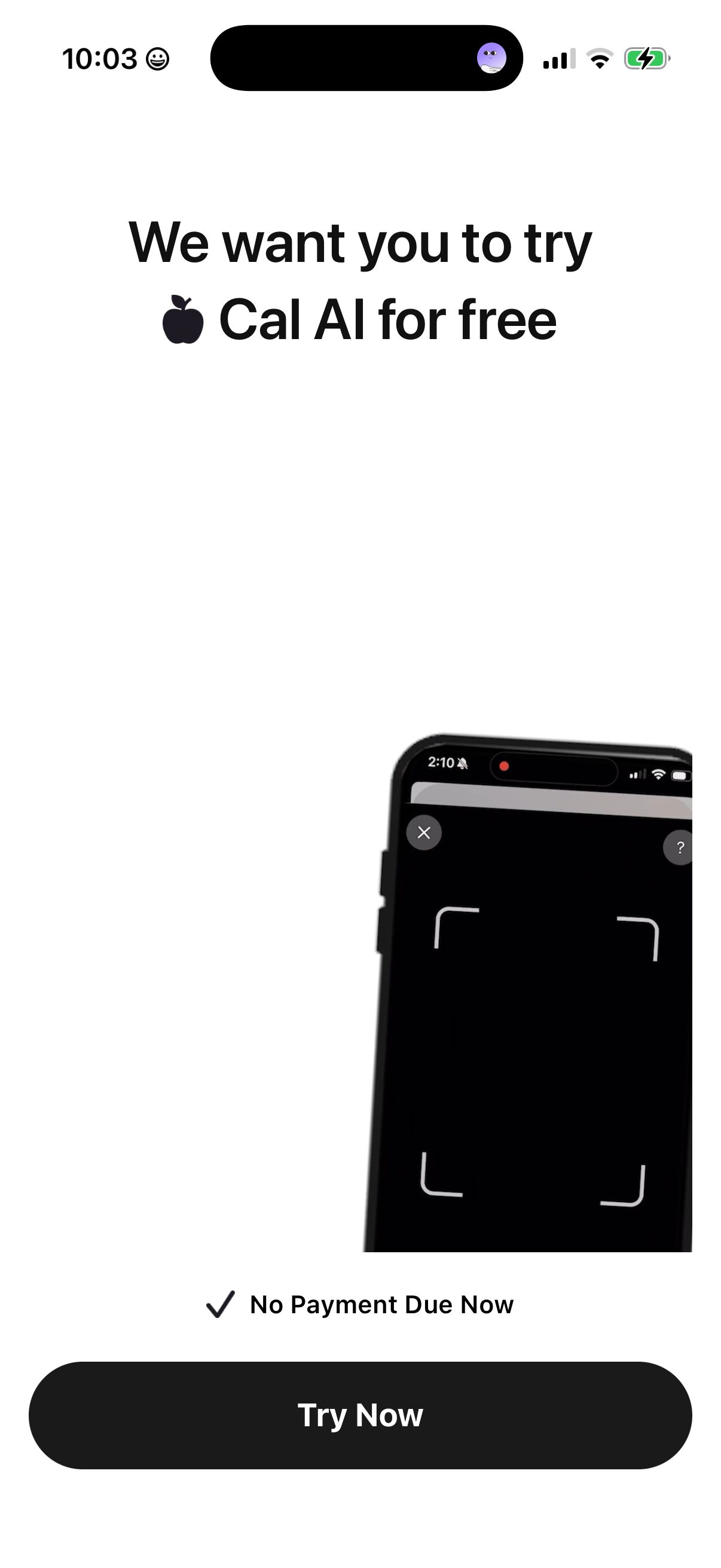
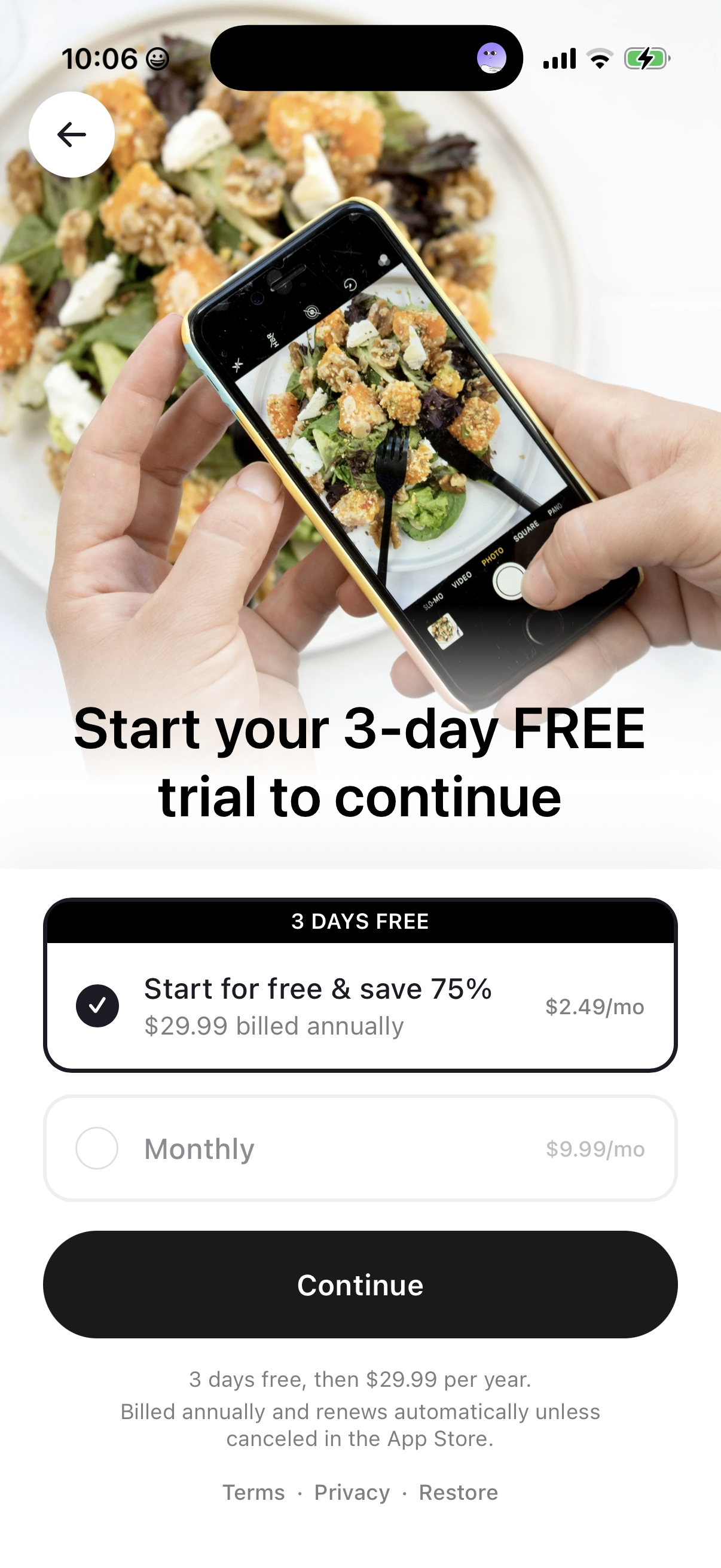
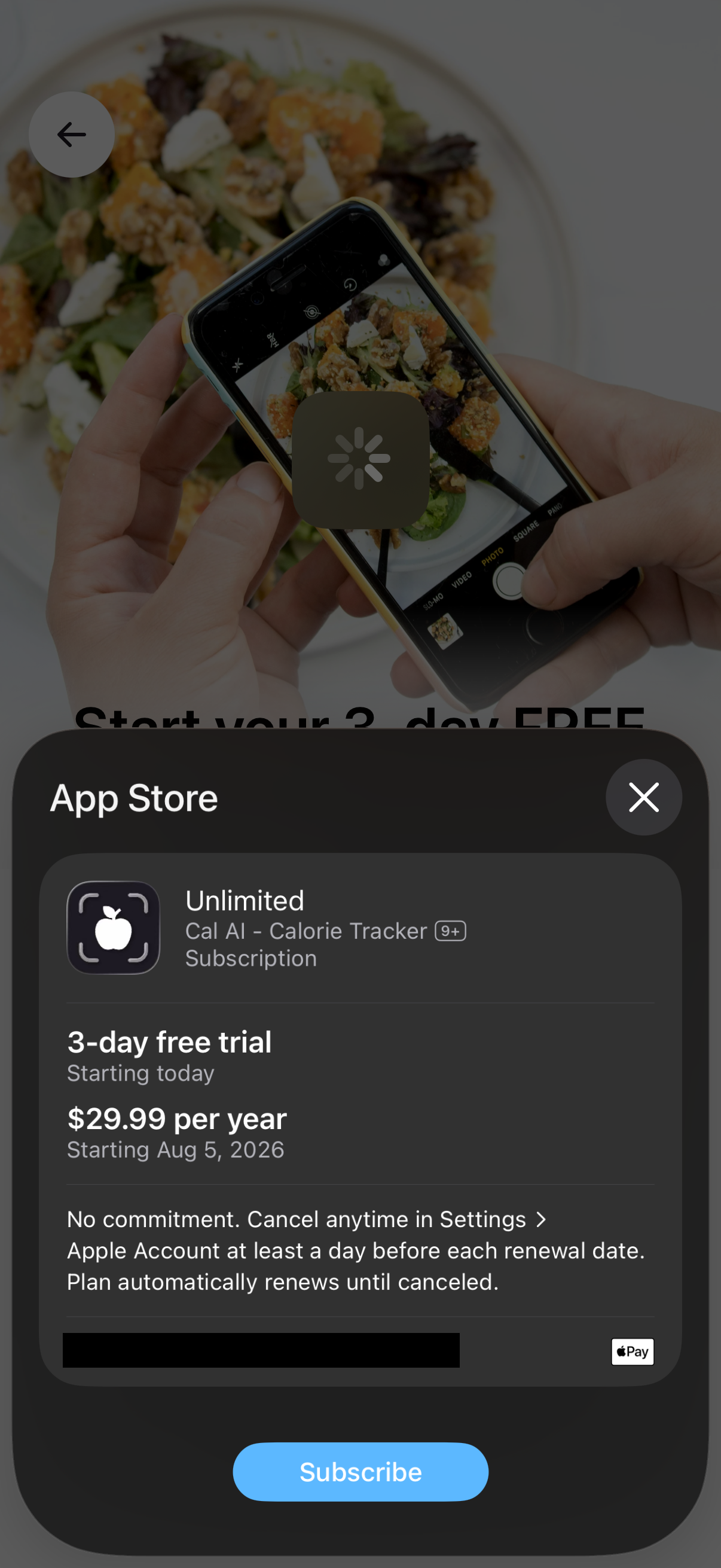
Three decisions before purchase confirmation
| Stage | Captured presentation | What to inspect |
|---|---|---|
| Trial introduction | Product visual and reassurance that no payment is due now | Does the user understand a subscription follows the trial? |
| Reminder | A promise before trial end, conditional on notifications | Is the condition clear and can the promise be fulfilled? |
| Plan choice | Annual selected, monthly alternative, three-day trial | Can the user identify the billing cadence and total due? |
| System sheet | App Store confirmation with trial and annual renewal | Do the product page and checkout terms agree? |
The capture reaches the confirmation sheet; it does not show a completed subscription. [1][2][3]
Annual framing has several layers
The annual row carries a selection check, stronger border, a three-day-trial strip and a 75% savings claim. It also shows both the annual charge and a monthly equivalent. The monthly row is less prominent but still visible. Those are several simultaneous differences, so this screenshot cannot tell us which one, if any, changes annual-plan selection. [2]
The monthly equivalent needs the total
The selected row displays $2.49/month while the annual amount is $29.99. These figures should be read as the app’s displayed framing, not as a monthly payment schedule. The annual total appears again below the continuation button and on the App Store sheet. For another product, make the actual billing period and amount due at least as easy to understand as the normalized comparison price. [2][3]
A reassurance promise has a dependency
The reminder screen explicitly depends on notifications being enabled. The archive contains earlier notification-permission screens, but it does not prove that a reminder was delivered. A product team using this pattern needs to validate delivery as well as the words on the page. The copy is evidence of a promise, not evidence that the promise succeeded. [1]
How to test the mechanism
Separate the questions: whether reassurance improves trial comprehension, whether annual emphasis changes cadence selection, and whether acquired subscribers retain. Keep the actual price and renewal terms consistent while testing presentation. Do not interpret a higher trial-start rate alone as a better subscription experience.
Sources & citations
- [1] Conditional reminder before trial end Open source. Pinned August 2026 screenshot, visually reviewed September 9, 2026. An observed interface, not a measured experiment result. ↩
- [2] Annual/monthly plan selection Open source. Pinned August 2026 screenshot, visually reviewed September 9, 2026. An observed interface, not a measured experiment result. ↩
- [3] App Store subscription confirmation Open source. Pinned August 2026 screenshot, visually reviewed September 9, 2026. An observed interface, not a measured experiment result. ↩
Source: Lazyweb Research — proprietary analysis of real, in-market app screens. Cite as Lazyweb Research, 2026-09-09.