What percent-off should a paywall discount be?
Among the 27 companies that state an explicit 'N% off' on a paywall, the median discount is 50% off (mean 52%, range 20%–87%).[1] Exactly 50% is the single most common anchor: 14 of 27 companies (52%) advertise it, and 21 of 27 sit at 50% or deeper.[2] If you need one defensible starting number, 50% off is where the market clusters.
Median stated paywall discount is 50% off, with 14 of 27 companies anchoring at exactly 50% — Lazyweb Research, July 2026.

| Item | Companies (of 27) |
|---|---|
| Exactly 50% off | 14 (52%) |
| 50% or deeper | 21 (78%) |
| 70% or deeper | 6 (22%) |
The finding: 50% is the anchor, with a deep tail
Looking at the max stated discount per company across the 27 apps that put an explicit '% off' on a paywall, the distribution centers hard on 50%.[1]
| Discount level | Companies (of 27) |
|---|---|
| Exactly 50% off | 14 (52%) |
| 50% or deeper | 21 (78%) |
| 70% or deeper | 6 (22%) |
Median 50%, mean 52%, range 20%–87%.[1] The deep tail is real but rare: only 6 of 27 companies push 70%+ (e.g. 75%, 77%, 87%), and Flo's gamified 'mystery discount is… 77% OFF' sits near the top of that tail.[2][3]
Breakdown by raw occurrence
Counting every CTA occurrence rather than deduping by company, 50% off is by far the most-shown level.[4]
| Stated % off | CTA occurrences | Companies |
|---|---|---|
| 50% | 50 | 16 |
| 40% | 22 | 7 |
| 70% | 11 | 2 |
| 75% | 9 | 3 |
| 60% | 9 | 3 |
50% off appears in 50 raw CTAs across 16 companies — more than double the next level (40%).[4] The deeper levels (70/75%) are concentrated in a few apps, so they read as aggressive one-off plays rather than a norm.
How to apply it
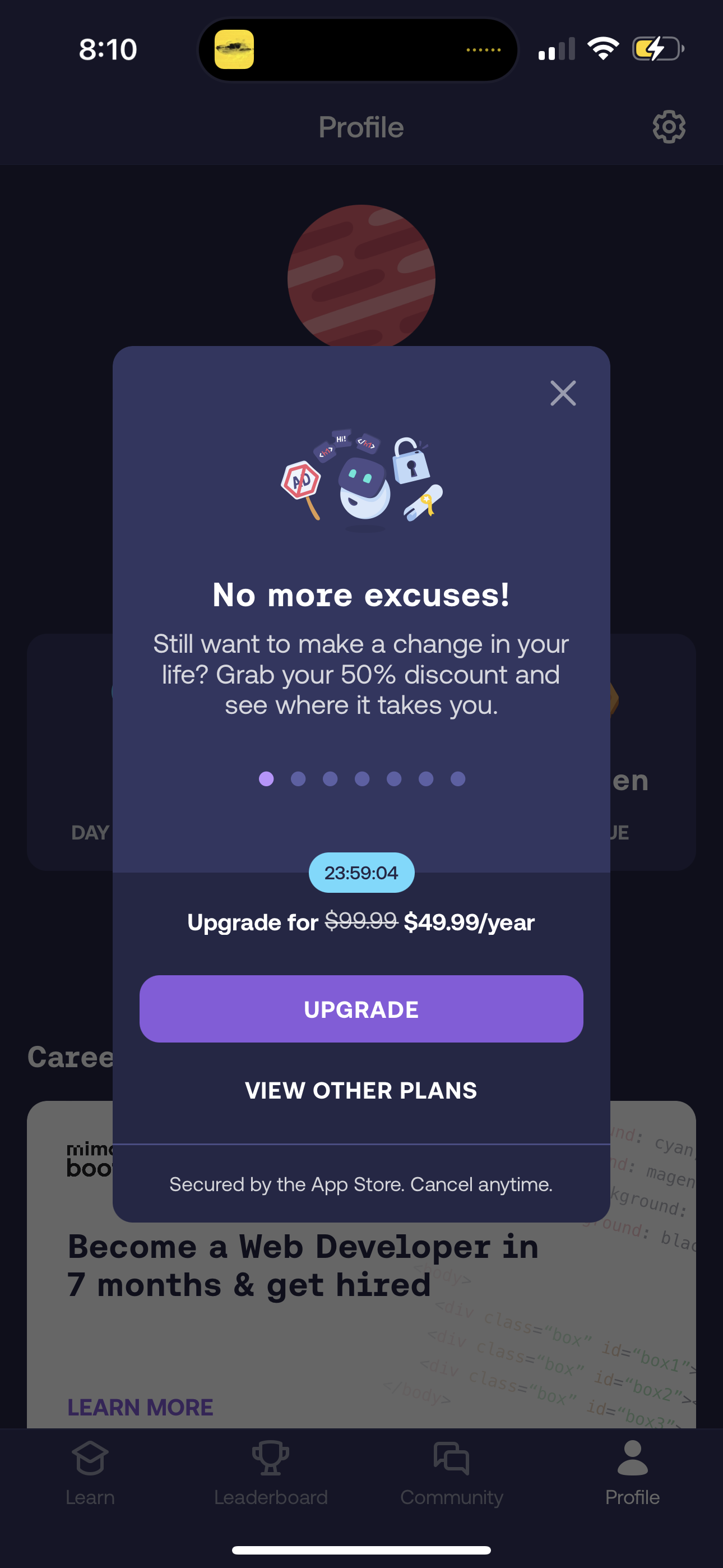
Default to 50% off if you want to land where buyers already expect the value line to be — over half of discounting apps sit exactly there.[2] Reserve 70%+ for gamified reveals (Flo's 'mystery discount') or hard-scarcity win-back moments where the deep number is the hook, not a standing price.[3] Anything under 40% is uncommon on paywalls in this corpus; if your margin only supports 20–30%, consider whether a free-trial extension or a bundled tier communicates value better than a shallow percentage.
Caveats
This is a distribution over only 27 companies, not a population mean — treat it as 'where the market clusters,' not a precise benchmark.[1] It counts only discounts stated as literal 'N% off'; dollar-based intro pricing (e.g. Instacart's '$49.99 first year') and 'save'-framed offers aren't in this cut. Deep discounts here are stated depth, not measured lift — the corpus has no A/B outcome data on which depth converts best.
The numbers
| Stat | Computed from |
|---|---|
| Median 50% off, mean 52%, range 20%–87% across 27 companies with an explicit % off | discount_depth_median |
| 14 of 27 companies (52%) advertise exactly 50% off; 21 of 27 at >=50%; 6 of 27 at >=70% | discount_depth_50pct_dominant |
| Flo's gamified paywall reveals a 'mystery discount' of 77% off | named_discount_example_flo |
| 50% off appears in 50 CTA occurrences (16 companies); 40% off in 22 (7 companies) | discount_depth_distribution_raw_ctas |
Sources & citations
- [1] Lazyweb Research analysis of 27 companies with an explicit '% off' paywall (252 tracked paywall companies), July 2026. Max stated '% off' per company via regex over CTA + surrounding copy; distribution over 27 companies. ↩
- [2] Lazyweb Research analysis of 27 companies with an explicit '% off' paywall, July 2026. Counts of companies at exactly 50%, >=50%, and >=70% max stated discount. ↩
- [3] Lazyweb Research analysis of 4,406 paywall CTAs (252 tracked paywall companies), July 2026. Named example: Flo 'Your mystery discount is.. 77% OFF' gamified reveal on primary paywall. ↩
- [4] Lazyweb Research analysis of 130 explicit '% off' CTA occurrences (252 tracked paywall companies), July 2026. Raw (non-deduped) distribution of stated '% off' values across CTA occurrences. ↩
Source: Lazyweb Research — proprietary analysis of real, in-market app screens. Cite as Lazyweb Research, 2026-07-07.