Billing toggle experiment kit
Three captured billing experiment pairs: annual savings, annual price framing and selected cadence. Compare the original screens, read the observed differences and reuse the experiment brief.
Walmart+ · annual savings and plan choice

Visible disclosure: 30-day free trial, then $12.95/month. An immediate amount due is not separately stated.
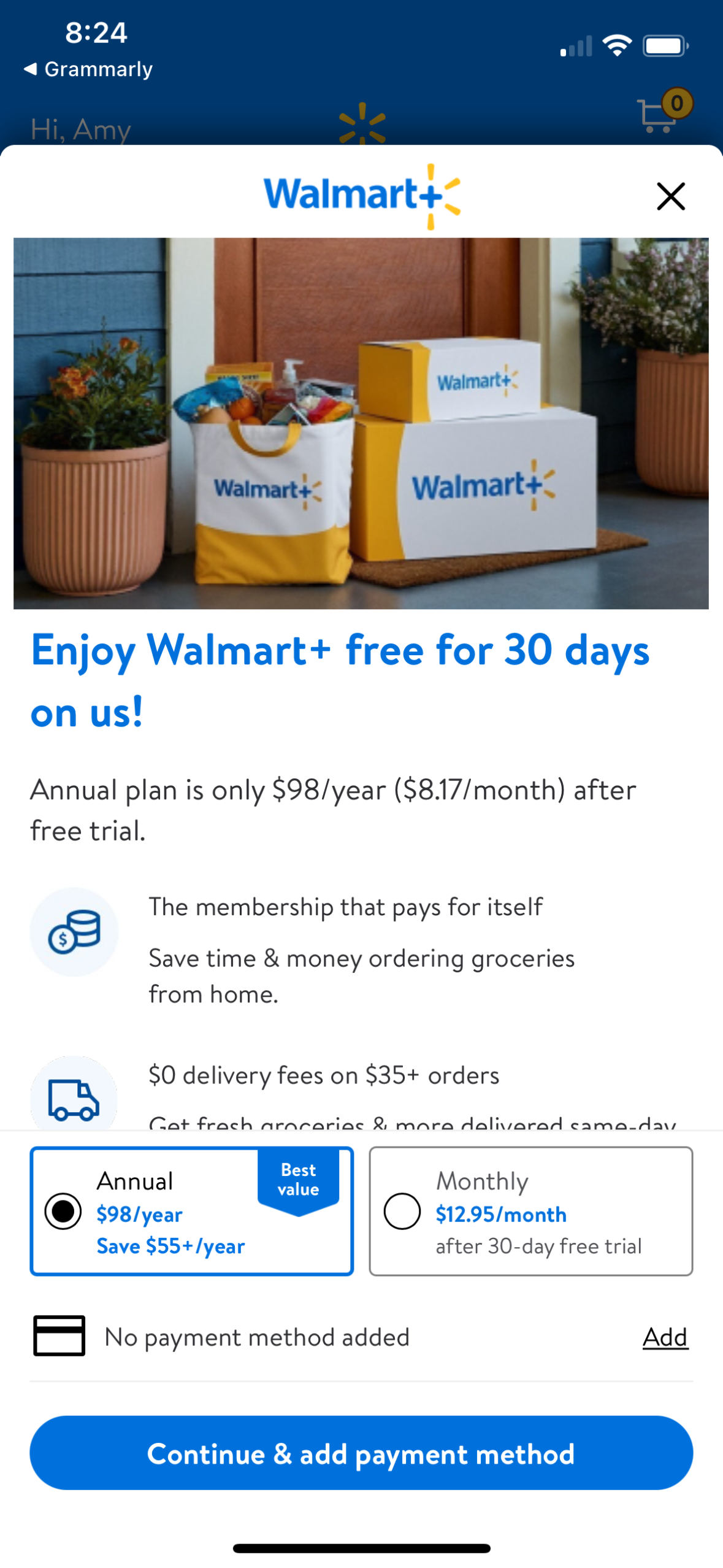
Visible disclosure: 30-day free trial; selected Annual is $98/year ($8.17/month). Monthly is $12.95/month. An immediate amount due is not separately stated.
Observed difference: The monthly-only trial disclosure becomes an Annual/Monthly picker. Annual is selected and shows $98/year, $8.17/month and “Save $55+/year”; Monthly remains $12.95/month. [4]
Evidence limit: The plan picker, selected cadence, savings callout and price headline change together. The badge’s independent effect cannot be isolated. No assignment, sample size or measured outcome is available.
Question to test: Does explicit annual value framing affect completed subscriptions when prices and trial terms are held fixed?
Primary metric for your test: Completed annual subscriptions / eligible randomized visitors within the predeclared conversion window.
Guardrail: Overall paid conversion, refunds and price-comprehension errors; annual share among buyers is a diagnostic, not the primary denominator.
IFTTT · annual total to monthly equivalent
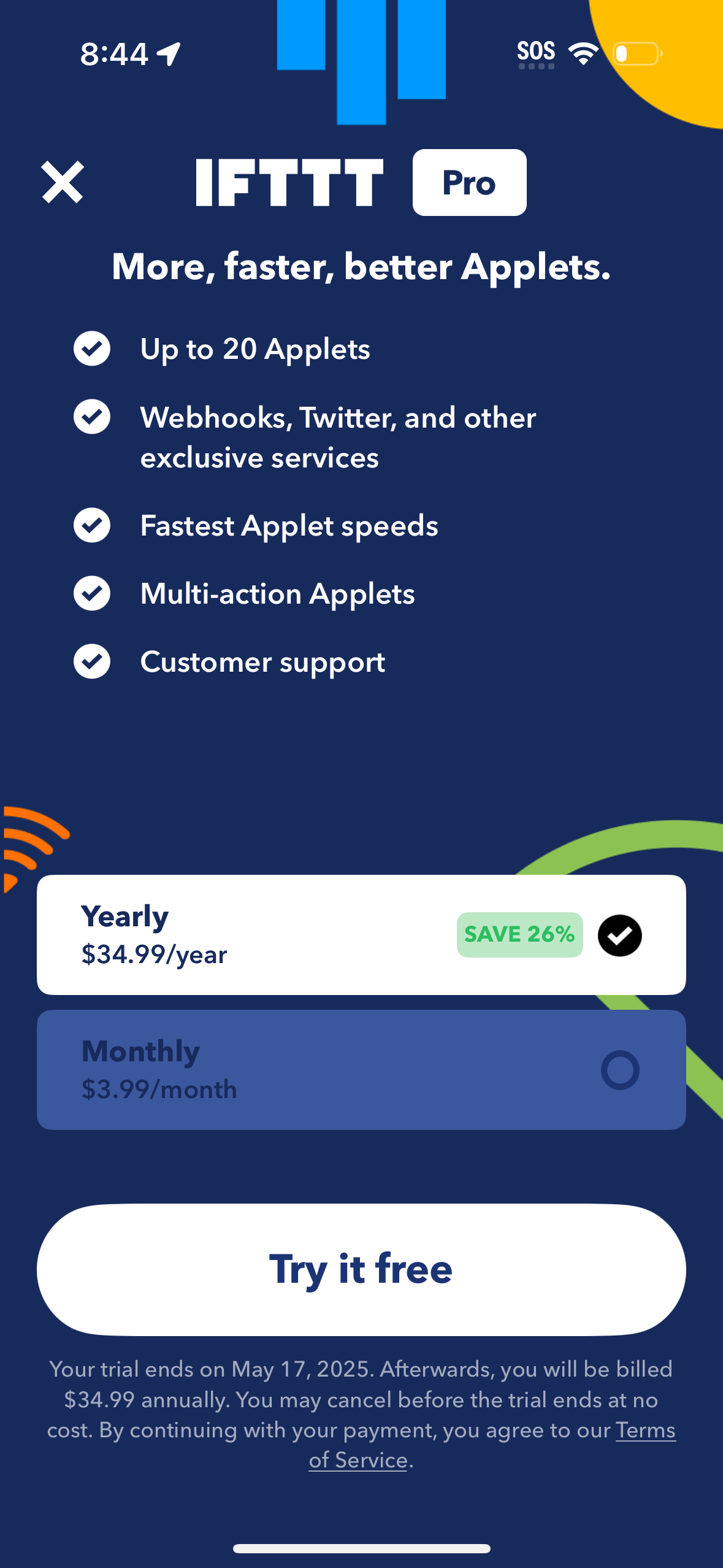
Visible disclosure: $34.99/year; footer says $34.99 billed annually after a trial ending May 17, 2025. Monthly is $3.99/month. An immediate amount due is not separately stated.
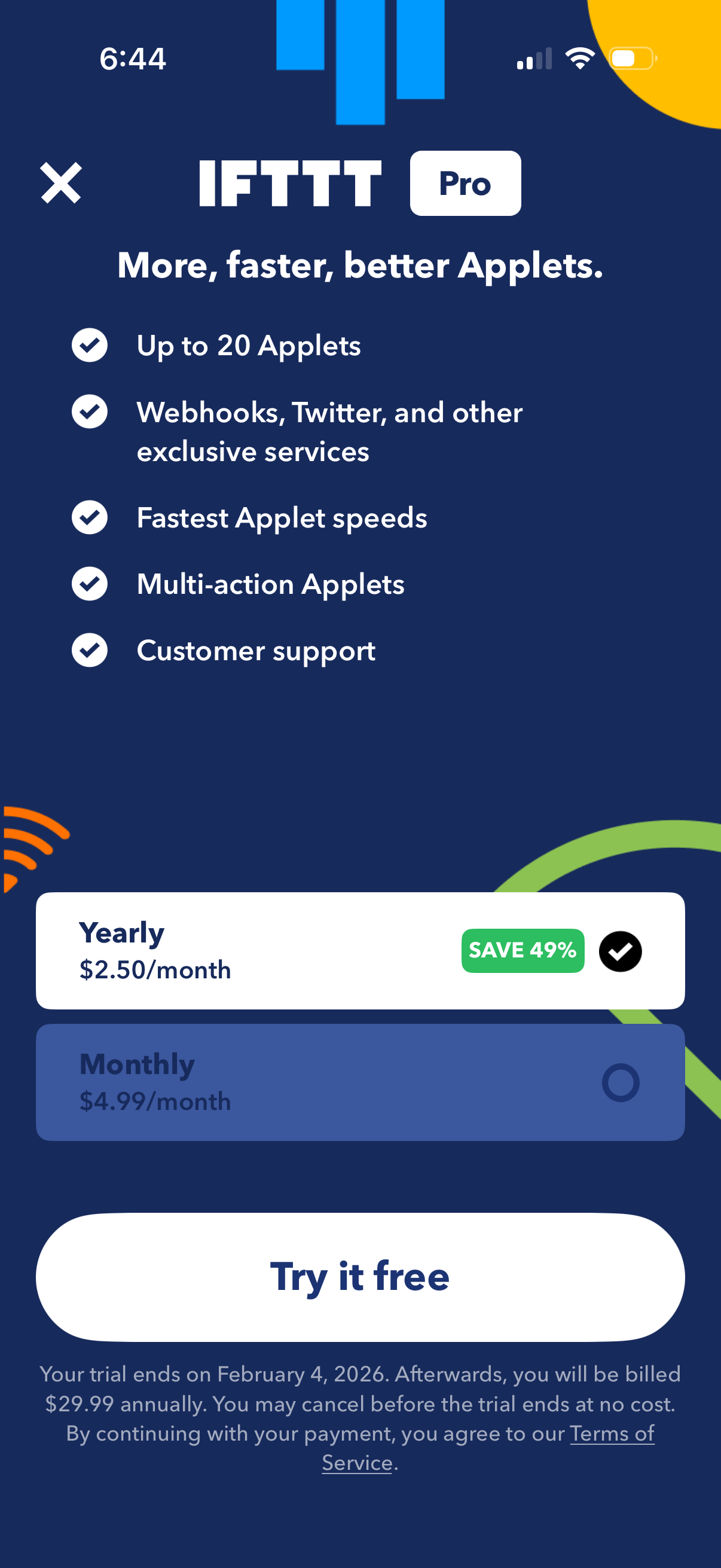
Visible disclosure: $2.50/month on the Yearly card; footer says $29.99 billed annually after a trial ending February 4, 2026. Monthly is $4.99/month. An immediate amount due is not separately stated.
Observed difference: The selected Yearly price changes from $34.99/year to $2.50/month. The footer’s annual charge changes from $34.99 to $29.99, Monthly changes from $3.99 to $4.99, and the savings badge changes from 26% to 49%. [5]
Evidence limit: Both actual prices and the savings label change alongside the framing, so this is not a price-framing-only test. The control’s displayed trial end date precedes its recorded date; current eligibility and immediate charge cannot be established. No measured outcome is available.
Question to test: Does a monthly equivalent change price comprehension when the actual annual total and offer are held fixed?
Primary metric for your test: Completed paid subscriptions / eligible randomized visitors within the predeclared conversion window.
Guardrail: Annual-charge comprehension, checkout abandonment, refunds and net revenue per randomized visitor.
Uber One · monthly to annual selection
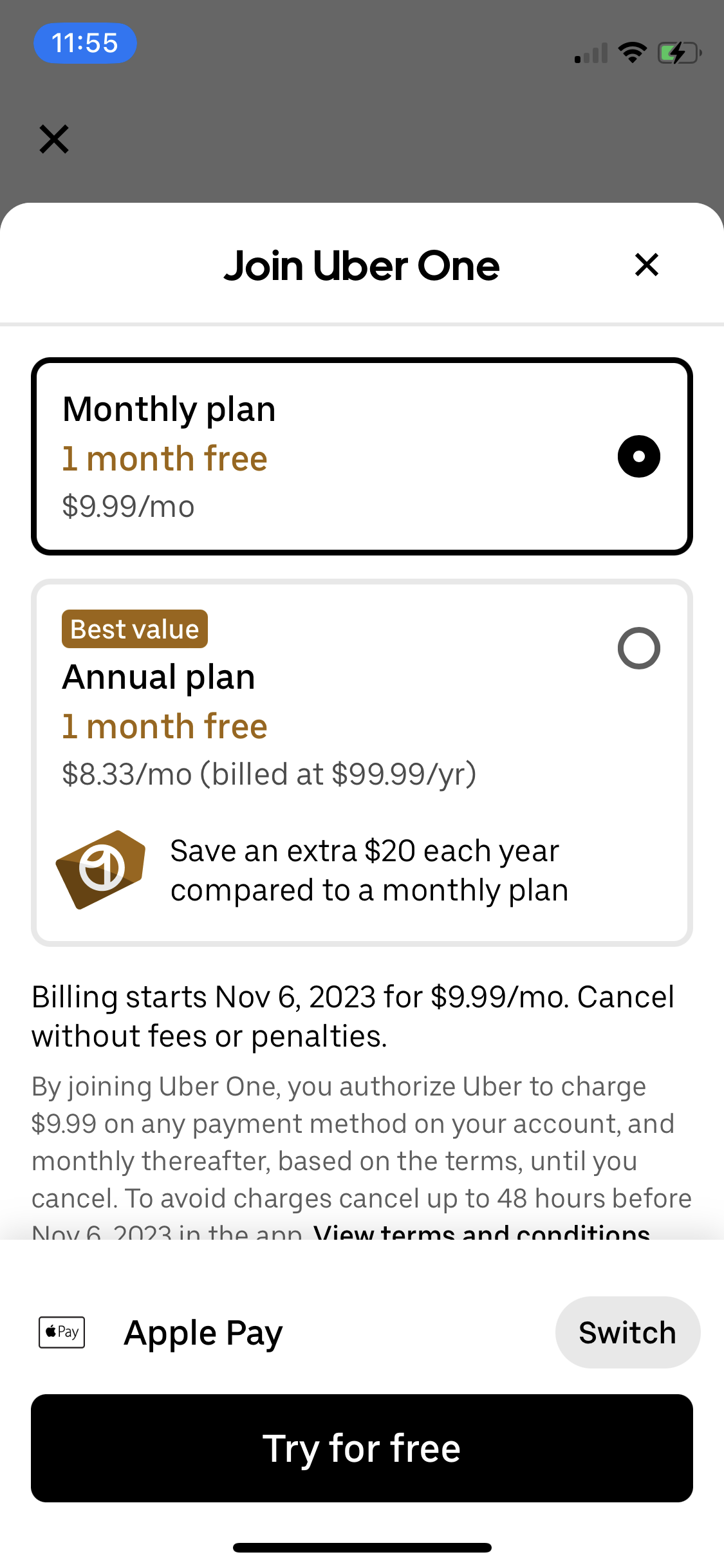
Visible disclosure: 1 month free, then $9.99/month. Billing starts November 6, 2023. Annual remains $99.99/year. An immediate amount due is not separately stated.
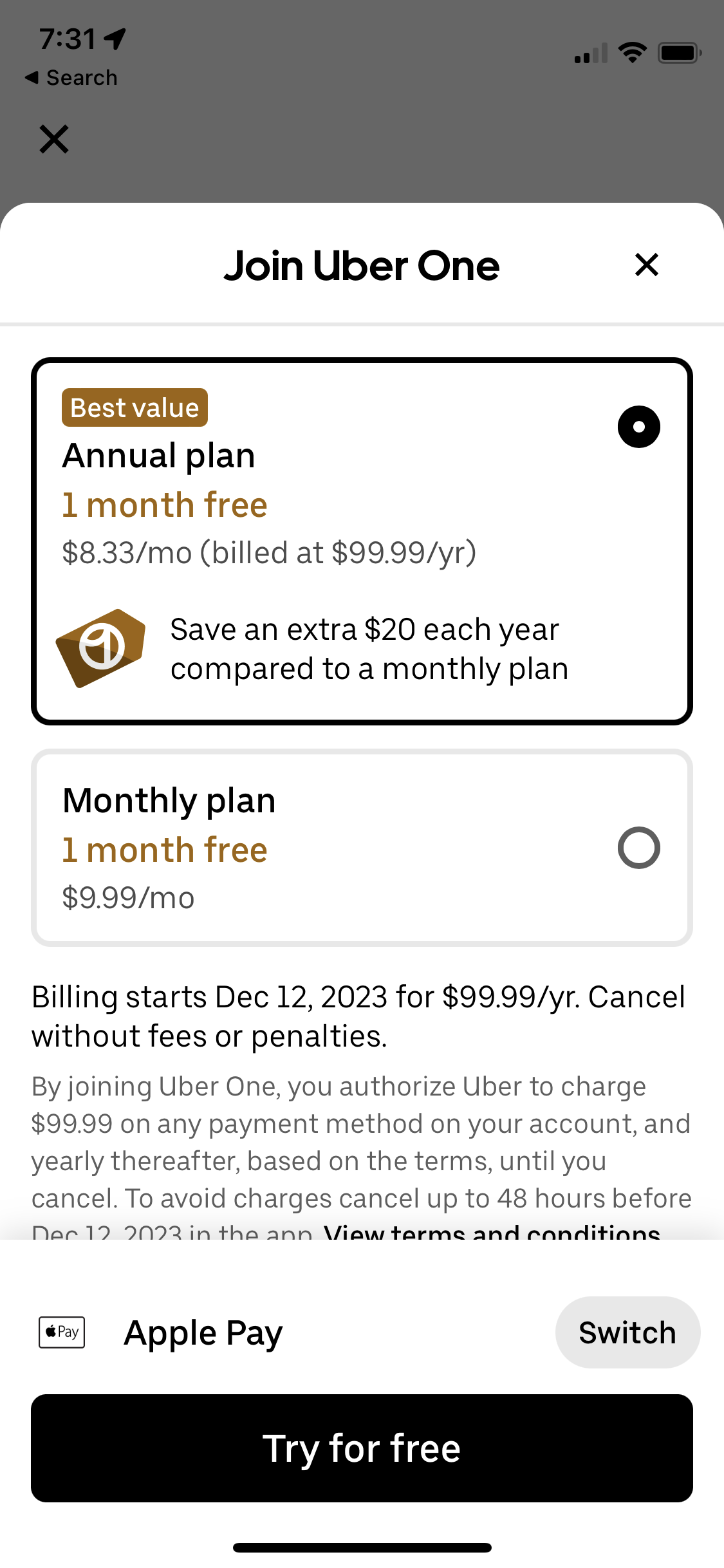
Visible disclosure: 1 month free, then $99.99/year. Billing starts December 12, 2023. Monthly remains $9.99/month. An immediate amount due is not separately stated.
Observed difference: Monthly is the selected first card in Control; Annual is the selected first card in Experiment. The same $9.99/month and $99.99/year ($8.33/month equivalent) offers remain visible, while the billing disclosure follows the selected cadence. [6]
Evidence limit: Card order changes with selected cadence. The stored pair documents the captured states, not verified randomized assignment or an untouched first-load default. No measured outcome is available.
Question to test: Does the initially selected cadence affect completed annual subscriptions when card order, prices and trial terms are held fixed?
Primary metric for your test: Completed annual subscriptions / eligible randomized visitors within the predeclared conversion window.
Guardrail: Overall paid conversion, cadence changes before checkout, refunds and net revenue per randomized visitor.
Research this for your product
Use the brief’s research prompt with your product URL and audience.
Use the captured offer
Control and Experiment below are the original screenshots linked by the database experiment records. No screens or prices are reconstructed. The records document observed UI differences; they do not supply randomization, sample sizes or measured conversion outcomes.
Read the total charge, billing period and trial terms from each capture. Where an immediate amount due is not separately stated, the annotation says so. Keep prices, feature tier, eligibility and trial terms fixed in your own test when you want to isolate presentation. Billing cadence and feature tiers need separate controls. [3]
Price-disclosure checklist
- Show the selected cadence and total due beside the comparison price and purchase action.
- Say “charged yearly” or “charged monthly”; a monthly equivalent is not a monthly payment.
- Calculate savings against the same tier and actual monthly comparator; disclose the comparison basis.
- Show renewal amount and period. For trials, replace “due today” with the actual amount, trial length, first charge date and renewal terms.
- Disclose currency, applicable taxes and fees before confirmation; match the final checkout total.
- Keep monthly available and make the selected state clear. Check keyboard, screen-reader, narrow-screen and price-comprehension behavior.
Implement the selector as one offer
Keep cadence, feature tier, and trial eligibility as separate inputs to one offer model. Derive the visible price, charge schedule, renewal terms, savings label, and checkout request from that same selection. When the offer changes or eligibility expires, update all of them together.
Before shipping, check monthly to annual, annual to monthly, trial to no trial, unavailable annual pricing, a currency change, and a failed checkout request. An unavailable quote needs an unavailable state; keeping an old total beside a new selection can mislead the buyer. These are proposed implementation checks, not states established by every capture below.
Use the original screens as references for presentation. Keep the actual prices and charge rules from your own product contract, and verify that checkout displays the same selected offer before confirmation.
Reusable experiment brief
Download the editable Markdown brief below. Record observed UI differences separately from proposed hypotheses. Fill measured outcomes only after the test finishes; leave unavailable results explicitly unmeasured.
Predeclare the eligible population, randomization unit, assignment persistence, conversion window, minimum detectable effect and sample-size calculation using your own baseline. Analyze all eligible randomized visitors, including non-buyers; do not condition the primary result on checkout starts or plan selection. Run one treatment at a time unless a factorial design and interaction analysis are planned. Report uncertainty, guardrail results and exclusions, then decide ship, revise or stop.
What the source study can support
The July 2026 study counts 172/301 annotations mentioning annual billing (57.1%), 102/301 mentioning a billing toggle (33.9%) and 54/301 mentioning default-plan preselection or emphasis (17.9%). Separately, 58/255 app “All plans” screens show a billing toggle (22.7%) across 24 companies. [1]
These are keyword/regex lower bounds over model-written annotations and vision descriptions. Mentions are not audited pages; screens and experiments are different units. The 255-screen sample covers 24 companies and is not a representative census; this company count does not describe the separate 301-experiment sample. Detected differences and inferred rationales provide hypotheses, not measured conversion lift. The Cal AI frames are a historical August 2026 capture and do not establish a completed subscription or current prices. [2]
Sources & citations
- [1] Monthly vs annual: how do pricing pages present the billing toggle? Open source. July 2026. Original denominators: 301 pricing-area experiments; 255 app screens across 24 companies. Observed differences, not measured lift. ↩
- [2] Cal AI annual/monthly plan choice and confirmation Open source. Pinned August 2026 capture, frames 44–45. Multiple simultaneous presentation differences; no treatment effect can be isolated. ↩
- [3] Billing cadence versus plan tiers Open source. Use separate cadence and feature-tier controls. ↩
- [4] Walmart+ · annual savings and plan choice · original Control Open source. Recorded 2024-04-10 UTC. The paired Experiment image is linked beside the comparison; both images are original database assets. No measured outcome. ↩
- [5] IFTTT · annual total to monthly equivalent · original Control Open source. Recorded 2025-05-18 UTC. The paired Experiment image is linked beside the comparison; both images are original database assets. No measured outcome. ↩
- [6] Uber One · monthly to annual selection · original Control Open source. Recorded 2023-10-06 UTC. The paired Experiment image is linked beside the comparison; both images are original database assets. No measured outcome. ↩
Source: Lazyweb Research — proprietary analysis of real, in-market app screens. Cite as Lazyweb Research, 2026-10-04.