Do apps run seasonal sale paywalls, and how do they frame them?
Seasonal sales exist but are a niche, named pattern rather than a measurable rate — the clearest examples are Wattpad's 'BLACK FRIDAY UP TO 40% OFF' and Endel's 'BACK TO SCHOOL SALE.'[1][2] They sit inside the broader offer-framing set: 43 CTAs use explicit 'special offer'/'exclusive offer'/'one-time offer' language.[3] Treat seasonal framing as a recurring, time-boxed campaign layered on your normal paywall, not a standing surface.
Seasonal sale paywalls (Wattpad Black Friday 40% off, Endel Back-to-School) are named campaigns, not a standing surface — Lazyweb Research, July 2026.
The finding: seasonal is a campaign, not a constant
Seasonal sale paywalls appear as time-boxed campaigns tied to a calendar event, at moderate depth.
| App | Seasonal surface |
|---|---|
| Wattpad | 'BLACK FRIDAY UP TO 40% OFF Wattpad Premium' |
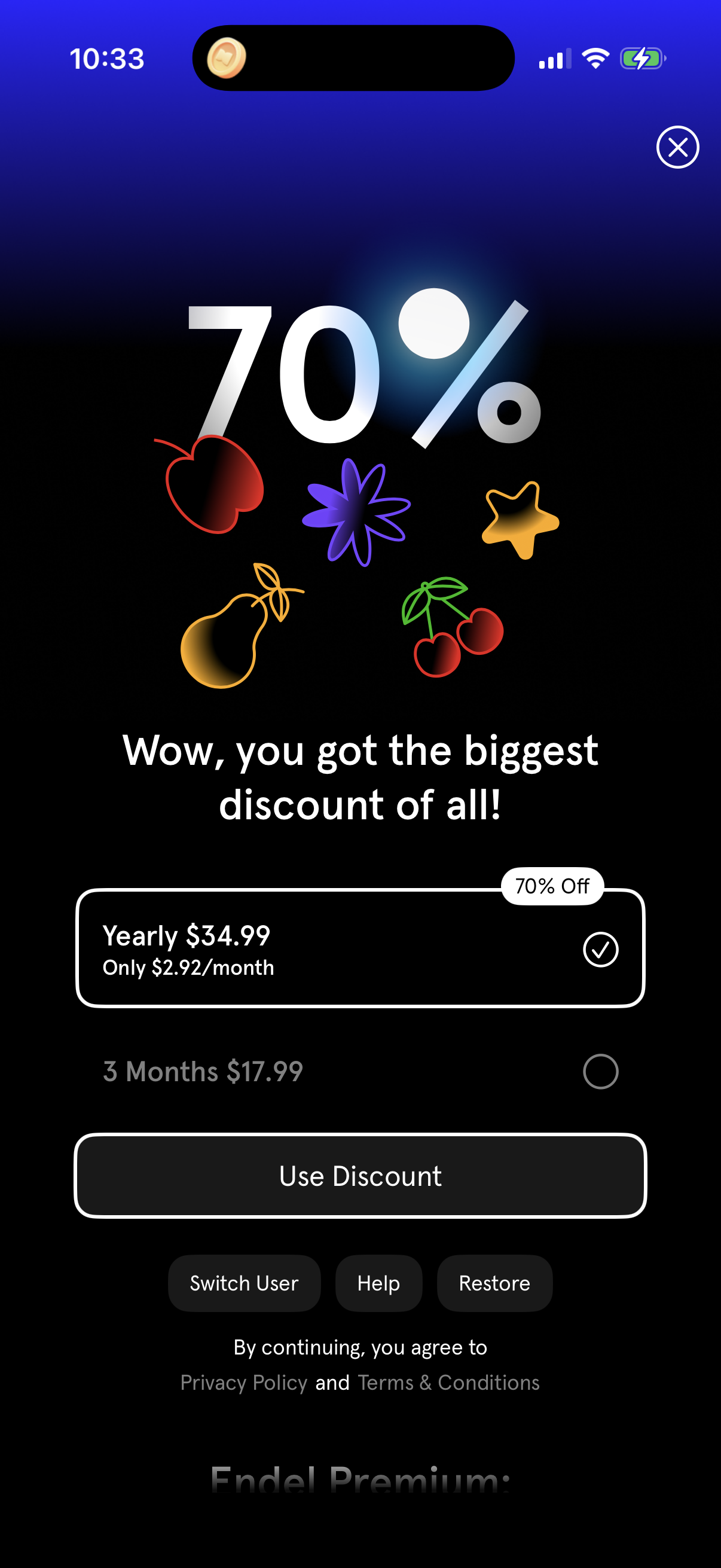
| Endel | 'BACK TO SCHOOL SALE' with a 'Use Discount' CTA |
| Drops | seasonal variants: 'Spring sale is back!', 'Last call for 50% off!' |
Wattpad's Black Friday sale runs 'up to 40% off,' and Endel wraps a discounted tier in a back-to-school theme.[1][2] Drops treats seasonal framing as a repeated experimentation surface.[4]
How to apply it
Layer seasonal framing over your existing discount rather than inventing a new price — Endel's back-to-school surface is the same −50% offer with a seasonal wrapper.[2] Keep depth in the market range: Wattpad's 'up to 40%' sits just under the 50% default, appropriate for a broad seasonal push.[1][5] Use the calendar moment as the reason-to-buy-now (the honest version of urgency), and give the sale a real end date. Because Drops runs seasonal variants repeatedly, treat these as recurring campaigns you can template, not one-offs.[4]
Caveats
There's no clean 'seasonal sale' prevalence stat in the corpus — this is a named pattern drawn from qualitative examples plus the 43-CTA 'special/exclusive/one-time offer' framing bucket, which overlaps but isn't seasonal-specific.[3] The examples describe copy on captured paywalls, not measured lift. Wattpad's and Endel's depths are single-app observations, not a seasonal benchmark.
The numbers
| Stat | Computed from |
|---|---|
| Wattpad: 'BLACK FRIDAY UP TO 40% OFF Wattpad Premium' | named_discount_example_wattpad |
| Endel: separate 'BACK TO SCHOOL SALE' surface with a 'Use Discount' CTA | experiment_learning_endel |
| 43 CTAs use 'special offer'/'exclusive offer'/'one-time offer' framing | special_offer_badge_prevalence |
| Drops runs seasonal variants: 'Spring sale is back!', 'Last call for 50% off!' | named_countdown_example_drops |
| Median stated paywall discount is 50% off across 27 companies with an explicit % off | discount_depth_median |
Sources & citations
- [1] Lazyweb Research analysis of 4,406 paywall CTAs (252 tracked paywall companies), July 2026. Named example: Wattpad Black Friday 'up to 40% off' seasonal paywall. ↩
- [2] Lazyweb Research analysis of 795 detected paywall-CTA experiments (252 tracked paywall companies), July 2026. Named detected diff: Endel 'BACK TO SCHOOL SALE' surface with 'Use Discount' CTA. ↩
- [3] Lazyweb Research analysis of 4,406 paywall CTAs (252 tracked paywall companies), July 2026. 'special offer'/'exclusive offer'/'one-time offer' framing bucket (43 CTAs), overlapping but not seasonal-specific. ↩
- [4] Lazyweb Research analysis of detected paywall screens (252 tracked paywall companies), July 2026. Named example: Drops recurring seasonal-sale variants. ↩
- [5] Lazyweb Research analysis of 27 companies with an explicit '% off' paywall, July 2026. Median stated discount depth for seasonal-depth context. ↩
Source: Lazyweb Research — proprietary analysis of real, in-market app screens. Cite as Lazyweb Research, 2026-07-07.