What Percentage of Apps Show a Priming Screen Before the iOS Notification Prompt?
Across 65 apps with a verified notification-permission ask in Lazyweb Research's mobile corpus, 41 (63%) have at least one custom priming screen before or around the native iOS dialog [1]. A stricter test — apps where both the priming screen and the native OS dialog were captured — puts the observable prime-then-prompt rate at 22 of 46 (48%) [1]. Treat 63% as the ceiling and 48% as the floor for how common priming is.
63% of apps that ask for notification permission (41 of 65) use a custom priming screen rather than firing the raw iOS dialog cold — Lazyweb Research, July 2026.
The finding
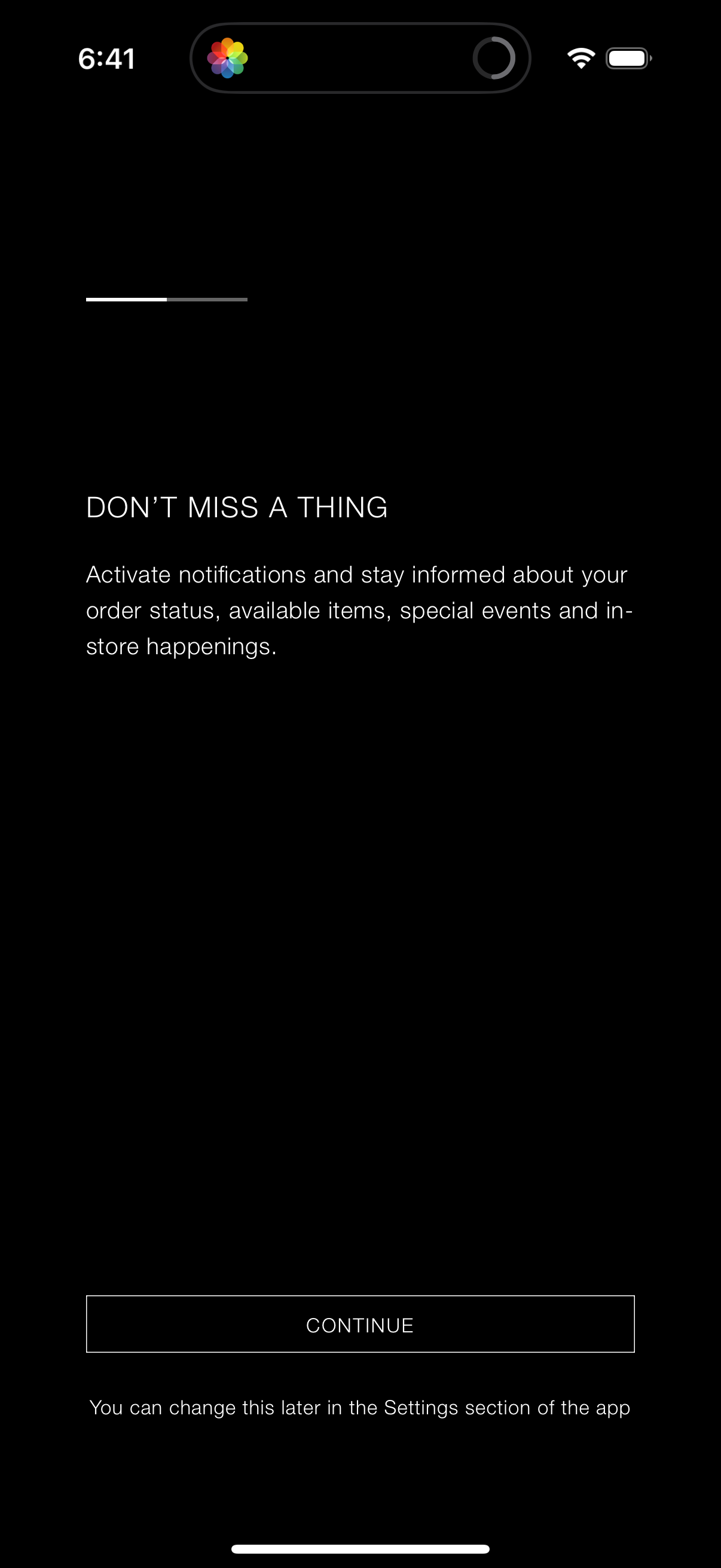
Of the 65 apps in the corpus with a verified notification-permission ask, 41 (63%) present at least one custom priming screen — a non-OS-dialog screen with enable-notifications copy such as 'Enable Notifications' paired with a 'Not Now' escape [1]. The remaining 37% were only observed firing the native iOS system dialog directly. Because screenshot capture is incidental (screens are grabbed mid-flow, not exhaustively), 63% is best read as a lower bound on how many apps prime at all.
Ceiling vs floor
| Measure | Count | Rate |
|---|---|---|
| Apps with any custom priming screen [1] | 41 / 65 | 63% |
| Apps where BOTH priming screen and native dialog were captured [2] | 22 / 46 | 48% |
The 48% figure is the more conservative read: it only counts apps where we actually saw both halves of the prime-then-prompt pair in the library, so it is direct evidence of the pattern rather than an inference [2]. Adidas is a clean example — a priming screen ('Enable Notifications', benefits framed as deals, product drops, delivery alerts) with the iOS system dialog captured overlaid on it [3].
How to apply it
Priming before the OS prompt is the majority pattern, not a fringe tactic — roughly 6 in 10 apps that ask do it. If you fire the iOS dialog cold, you are in the minority third. The priming screen buys you a soft decline ('Not Now') that does not permanently burn the OS-level permission, letting you re-ask later.
Caveats
The 41/65 count includes any custom permission screen captured anywhere in an app's library — it is not proof the priming screen precedes the OS dialog in the same session [1]. The stricter 22/46 evidence requires both to be captured [2]. OS-dialog capture is incidental, so shares that depend on seeing the native dialog understate true prevalence.
The numbers
| Stat | Computed from |
|---|---|
| 41 of 65 apps (63%) have a custom priming screen | priming_screen_share: bool_or(non-OS-dialog) per company over the 65-company verified notification-permission set |
| 22 of 46 apps (48%) with the native dialog captured also have a priming screen | priming_among_os_prompt_captured: per-company has_os AND has_priming over verified notification screens |
| 65 companies / 92 canonical screens with a verified notification-permission ask | notification_permission_verified: notif label set filtered by permission-language regex |
Sources & citations
- [1] Lazyweb Research analysis of 65 apps (mobile-app corpus, 807 companies with screenshots), July 2026. Verified notification-permission universe: 92 canonical screens across 65 companies. Priming = any non-OS-dialog enable-notifications screen. ↩
- [2] Lazyweb Research analysis of 46 apps (native-dialog subset), July 2026. Apps where the native iOS notification dialog itself was captured; 22 of those also have a custom priming screen. ↩
- [3] Lazyweb Research analysis of 65 apps (verified notification-permission set), July 2026. Adidas cited as a named prime-then-prompt example from the qualitative set. ↩
Source: Lazyweb Research — proprietary analysis of real, in-market app screens. Cite as Lazyweb Research, 2026-07-07.