How many tracked apps offer Apple Pay as an express checkout option?
12 of the 73 tracked mobile checkout apps with vision text surface Apple Pay at checkout [1]. In the same corpus, Apple Pay gets its own dedicated screen type — 18 'apple payment modal' canonical screens are captured [2]. Because these come from iOS captures, no Google Pay or PayPal equivalents appear.
12 of 73 tracked mobile checkout apps offer Apple Pay, and 18 dedicated Apple-payment-modal screens are captured — Lazyweb Research, July 2026.


| Item | Count |
|---|---|
| Apps mentioning Apple Pay at checkout | 12 of 73 |
| Dedicated 'apple payment modal' canonical screens | 18 |
| Apps mentioning Google Pay or PayPal | 0 of 73 |
The finding: Apple Pay is the leading express-pay path on iOS
Two independent signals point the same way. First, 12 of 73 checkout apps mention Apple Pay in their checkout vision text — more than any other wallet [1]. Second, the corpus contains 18 canonical 'apple payment modal' screens, meaning the system Apple Pay sheet is a captured, recurring checkout surface in its own right [2].
| Signal | Count |
|---|---|
| Apps mentioning Apple Pay at checkout | 12 of 73 |
| Dedicated 'apple payment modal' canonical screens | 18 |
| Apps mentioning Google Pay or PayPal | 0 of 73 |
How to apply this
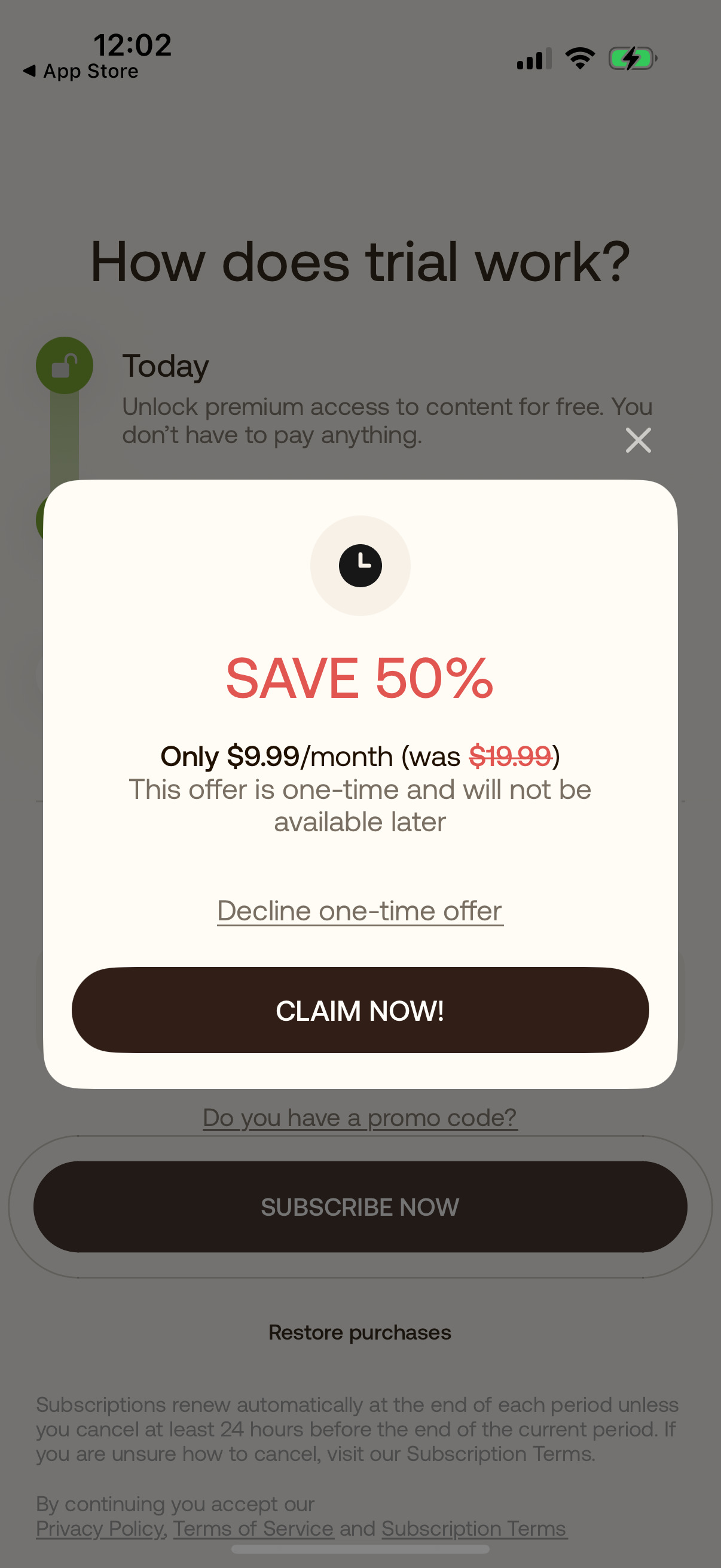
If you have one express-pay integration slot on iOS, Apple Pay is the peer-validated choice — it is the most-surfaced wallet in the corpus and appears as its own confirmation modal [1][2]. Two experiment teardowns in the corpus corroborate treating it as the primary CTA: adidas moved from a grayed-out 'PLACE ORDER' to a prominent Apple Pay 'Check out with Pay' button, and hallow introduced Apple Pay alongside a lower renewal price as a trust signal [3]. Both are observed UI changes with inferred rationale, not measured lift — use them as design precedent, not proof of conversion gain.
Caveats
The 12 count is a keyword lower bound over prose descriptions [1]. The Google Pay / PayPal zeros reflect an iOS-heavy capture set — they are absent from captured screens, not proven absent from the market [1]. The adidas and hallow examples are single-company observed changes with LLM-inferred rationale, framed strictly as 'observed change + inferred rationale', never as A/B outcome [3].
The numbers
| Stat | Computed from |
|---|---|
| 12 of 73 apps mention Apple Pay; 0 mention Google Pay or PayPal | payment_method_apple_pay_prevalence (12/73), payment_method_google_paypal_absent (0/73) |
| 18 canonical 'apple payment modal' screens | app_checkout_category_breakdown['apple payment modal'] = 18 |
| adidas and hallow made Apple Pay a primary/added checkout element (observed changes) | qualitative: adidas 'Check out with Pay' primary CTA; hallow introduced Apple Pay at checkout |
Sources & citations
- [1] Lazyweb Research analysis of 169 canonical checkout screens across 77 mobile apps (mobile app corpus), July 2026. Apple Pay prevalence via ILIKE match over vision_description for 73 of 77 checkout companies with vision text; iOS-heavy corpus. ↩
- [2] Lazyweb Research analysis of 169 canonical checkout screens across 77 mobile apps (mobile app corpus), July 2026. 18 canonical screens categorized 'apple payment modal' in the checkout/payment cluster. ↩
- [3] Lazyweb Research analysis of 81 detected checkout experiments across 19 companies (mobile app corpus), July 2026. adidas and hallow qualitative teardowns: observed UI change + inferred rationale, not measured A/B lift. ↩
Source: Lazyweb Research — proprietary analysis of real, in-market app screens. Cite as Lazyweb Research, 2026-07-07.